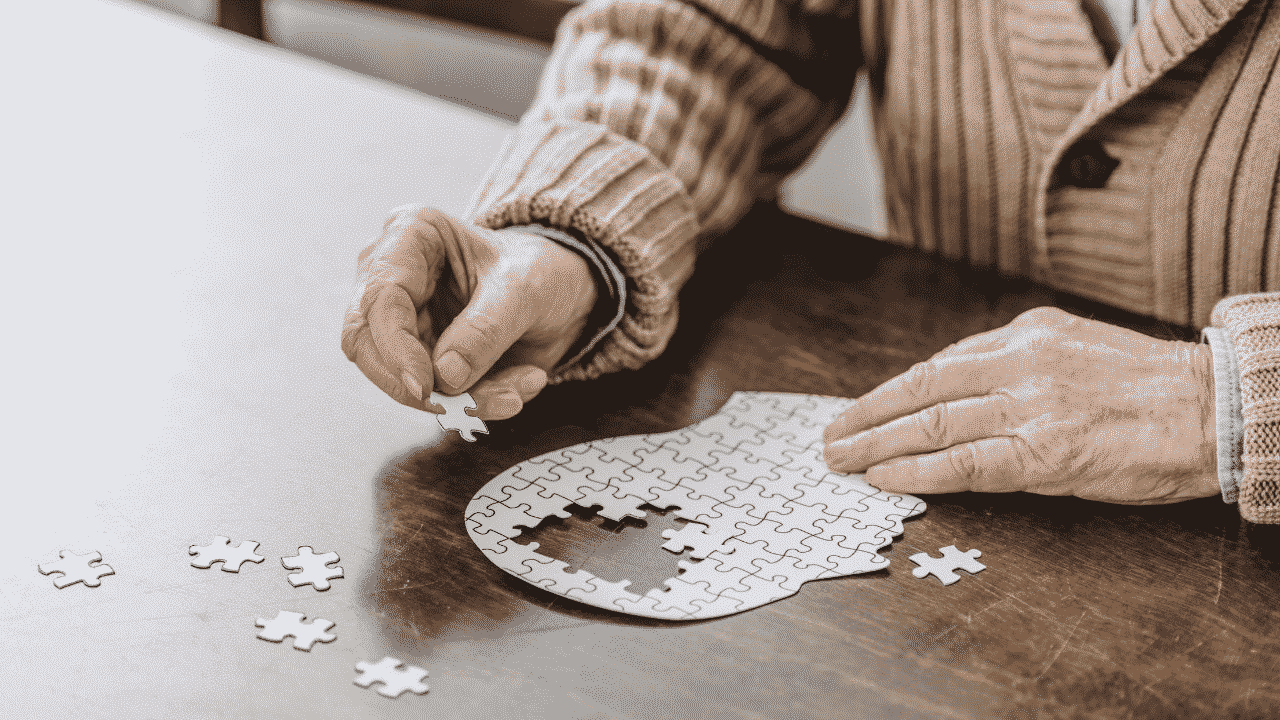
What happens to a person’s sense of self when memory begins to fray?
I often describe dementia as a fragmentation of self. And yet, even within that fragmentation, traces of identity persist- it is our job to look for the pieces and honor the person.
For William Utermohlen, famous artist, his symptoms began with difficulty tying his necktie, declining ability to manage household finances, increasing memory lapses, and a deterioration in writing. According to his wife at the time he was referred at age 61 he appeared depressed, subdued, and out of touch with his surroundings. According to his wife, symptoms had been present for about four years. There was no family history of neurological or psychiatric illness and his prior medical history was otherwise unremarkable, except for a motor-vehicle accident at age 55 that resulted in approximately 30 minutes of loss of consciousness (we now know that traumatic brain injury has been identified as a significant risk factor for dementia).
Alzheimer’s Dementia Self-Portraits by William Utermohlen
In 1995, the American-born, London-based painter William Utermohlen received an Alzheimer’s diagnosis. What followed is one of the most intimate visual records of dementia we have: a years-long series of self-portraits that documented his experience as an artist living with dementia.

Self-Portraits by William Utermohlen; www.williamutermohlen.com
1995: Diagnosis, “Blue Skies,” and a New Kind of Seeing
In 1995, William (“Bill” to those who loved him) learned he was living with Alzheimer’s disease. Not long after, he painted “Blue Skies” (1995)—his final large-scale work—just after the diagnosis.

Blue Skies, 1995 by William Ultemohlen, www.williamutermohlen.com
On the suggestion of a nurse on his care team…
Bill began a disciplined practice of self-portraiture. To me this was an act of love and humanity- honoring the person and artist, she knew Bill to be. The routine kept his artistic identity—“I am a painter”—active for as long as possible. And it produced a profound visual document of the psychological and physical effects of Alzheimer’s.
These portraits were eventually studied by clinicians and scholars, culminating in a notable paper in The Lancet (June 2001). The core idea that resonates so deeply for me is this: Acts of creation don’t merely show us the world; they reveal the creator. In dementia, that revelation is priceless. Too often, the illness shrouds the humanity of the person living with the illness.
I’m still here. I’m changing, but I’m here.
But in this profound artistic pursuit, William Utermohlen reminds us: I’m still here. I’m changing, but I’m here.
He lost the ability to paint by 2001. Bill died in London on March 21, 2007, after a long course of illness, cared for by his wife, friends, and professionals who walked beside them.
As caring professionals and family members, we are uniquely positioned, just as William Utermohlen’s nurse, to honor the person living with the illness. To really see them and to remind others to see them, too.
References:
- www.williamutermohlen.com
- Crutch, SJ (June 2001), Some Workman Can Blame Their Tools: Artistic change in an individual with Alzheimer’s Disease, The Lancet, Vol.357, No.9274, 30 June 2001, pp.2129. Full article here: www.williamutermohlen.com/the-lancet-june-2001

Dr. Regina Koepp is a board certified clinical psychologist, clinical geropsychologist, and founder and CEO of the Center for Mental Health & Aging: the “go to” place for mental health and aging. Dr. Koepp is a sought after speaker on the topics of mental health and aging, caregiving, ageism, resilience, intimacy in the context of life altering Illness, and dementia and sexual expression. Dr. Koepp is on a mission to ensure mental health and belonging for older adults, because every person at every age is worthy of healing, transformation, and love. Learn more about Dr. Regina Koepp here.
Regina Koepp, PsyD, ABPP























































































Want More? Read Our Most Recent Posts


Older adults deserve high quality mental health care.
Therapists deserve the training to provide that care.