
I think about a therapist who had been meeting with an older client every Tuesday for nearly a year. At first, the changes were easy to explain away: a missed appointment here, a repeated story there, a moment of losing track in the middle of a familiar conversation. But over time, the pattern became harder to ignore. The therapist found herself sitting with a tender question many of us face in this work: How do I respond in a way that protects this client’s dignity while also making room for the support they may now need?
If you’ve been working with an older client for a while, you may start to notice subtle shifts—missed appointments, repeated stories, difficulty tracking the thread of a session, or increasing anxiety about “losing it.” These moments can feel tender and complex. You’re holding a therapeutic relationship built on trust and autonomy, while also sensing that your client may soon need more support than they can manage alone.
At some point, the question arises: Is it time to bring family into the session?
This is rarely a purely clinical decision. It’s relational, ethical, and deeply human. Let’s walk through how to approach this in a way that preserves dignity, strengthens care, and supports everyone involved—including you.
What this article covers
- How to begin the conversation without undermining trust.
- What to consider when assessing readiness, capacity, and risk.
- How to prepare both the client and family member before a joint session.
- Ways to structure the first family session so it supports dignity and collaboration.
- Why clarifying roles, consent, and communication matters over time.
Start with the therapeutic alliance
Before involving anyone else, return to your foundation: your relationship with your client.
Even if cognitive changes are emerging, your client’s sense of autonomy and identity remains central. Bringing in family without careful conversation can feel like a betrayal or loss of control.
You might say something like:
“I’ve noticed a few changes lately that we might want more support around. Sometimes it can be helpful to include someone you trust—just to make sure we’re covering all the bases together. How would you feel about that?”
Notice that this frames family involvement as support, not surveillance or takeover.
Assess capacity and readiness
Not all memory changes mean your client is ready—or willing—to involve family. Some clients will welcome it. Others may feel ashamed, fearful, or resistant.
Consider:
- Can your client understand the purpose of including family?
- Are they able to express a preference?
- Is there any risk, such as family conflict, exploitation, or emotional harm?
If there are concerns about safety or capacity, you may need to proceed more carefully, potentially consulting clinical experts and ethical guidelines in your state.
But in most cases, clients can and should remain active decision-makers in who joins and how.
Frame it as a team-based approach
One of the most helpful shifts is moving from “adding a family member” to “building a care team.”
This reduces the sense that therapy is being taken away from the client and instead emphasizes collaboration.
You might say:
“You’re still at the center of this work. Bringing someone in just helps us make sure your goals are supported outside of our sessions too.”
This is especially important for clients who fear losing independence. You’re reinforcing that they are not being replaced—they are being supported.
Prepare both sides separately
Before a joint session, it’s often useful to have brief, separate conversations.
With your client:
- Clarify what they want shared, and what they do not.
- Identify their goals for the meeting.
- Explore any worries about how the family member might respond.
With the family member:
- Set expectations; this is not a “report” session.
- Emphasize respect for the client’s autonomy.
- Offer guidance on communication, such as avoiding correcting or quizzing memory.
This preparation can prevent the session from becoming tense, corrective, or unintentionally shaming.
Structure the first joint session thoughtfully
The first family session sets the tone for everything that follows.
A simple structure can help:
- Start by centering the client; invite them to share why they agreed to include their family member.
- Normalize the situation: “Many people experience changes like this, and it’s something we can navigate together.”
- Invite the family member’s perspective, while gently guiding tone and language.
- Identify shared goals, such as maintaining independence, reducing stress, or improving communication.
If memory impairment is noticeable, be mindful not to put the client on the spot. Avoid questions that require precise recall or that could highlight deficits.
Instead, focus on feelings, values, and preferences—areas where your client can still fully participate.
Address the emotional undercurrent
These conversations are rarely just about memory.
For clients, there may be grief, fear, or frustration.
For family members, there may be worry, confusion, or even denial.
Part of your role is to name and hold these emotions without letting them derail the session.
You might say:
“This can be a hard shift for everyone. It makes sense that there are a lot of feelings coming up.”
That simple acknowledgment can lower defensiveness and open space for more honest connection.
Clarify roles going forward
As therapy evolves, so will the role of family.
Be explicit about:
- When family will be included, whether every session, occasionally, or as needed.
- How information will be shared.
- What decisions remain with the client.
This is also a good time to revisit consent and confidentiality in a developmentally appropriate way.
Remember: involvement is not all-or-nothing. You can flex the level of family participation over time.
Protect the client’s dignity
Perhaps the most important thread through all of this is dignity.
Even as cognition changes, your client is still a person with a lifetime of identity, preferences, and agency.
Small choices matter:
- Speak directly to the client, not about them.
- Avoid infantilizing language.
- Highlight strengths and preserved abilities.
Family members often take cues from you. When you model respect, they are more likely to follow.
Conclusion
Bringing family into therapy is not a sign that your work with an older client is ending. In many cases, it is a way of widening support while staying grounded in the therapeutic relationship that has already been built.
When this is done thoughtfully, you help create a space where the client remains at the center, family members understand how to support without taking over, and hard emotions can be named without shame. That kind of work can strengthen care at a moment when clients and families often feel especially vulnerable.
I find that when clinicians approach this transition with clarity, consent, and respect, the therapy does not become smaller. It becomes more responsive to the client’s real life, which is often exactly what this stage of care requires.
Professionals: Want to Deepen Your Therapy Skills with Dementia?
If you’re building your clinical skills in this area, I recommend starting with:
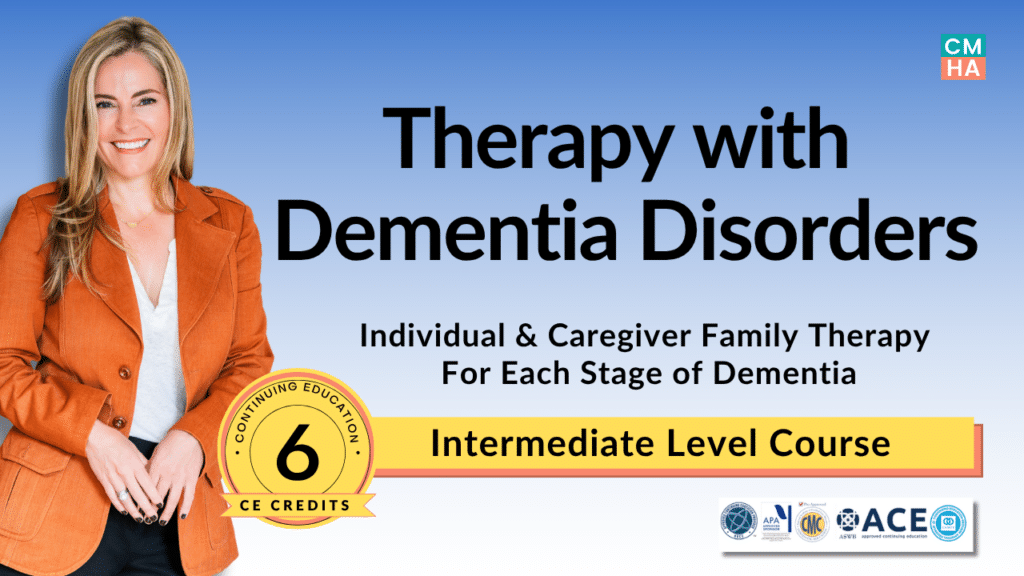
Therapy with Dementia Disorders (6 CE Credits)
Learn more here
In this training, we’ll go deep on how to apply a family systems lens to the full arc of dementia — from early diagnosis through end of life. You’ll leave with a clear clinical framework, practical tools, and a much stronger sense of how to show up for the families who need you most.
Caregiver Family Therapy maps directly onto the work of supporting families through each stage of dementia. This training will give you the clinical language and the practical skills to do it well.
Recommended Reading:
This is the most comprehensive framework I’ve found, and it’s clinically grounded without being overly prescriptive. Qualls and Williams write in a way that respects both the science and the messiness of real family life.
Qualls, S. H., & Williams, A. A. (2013). Caregiver Family Therapy: Empowering Families to Meet the Challenges of Aging. American Psychological Association.
Related Articles
- What is Caregiver Family Therapy
- Therapy for Families and Individuals Following a Difficult Move to Memory Care
- Deception, Relocation, and Dementia Care: Is it Ok to Lie to a Person About Moving To Memory Care?
- Transfer Trauma in Older Adults: Relocation Stress, Identity Loss, and How Therapy Can Help
- Grieving Someone Who’s Still Alive: Understanding Ambiguous Loss
- Separation Anxiety in Older Adults: What Every Clinician Needs to Know
- Do Caregivers Really Die Before Their Loved Ones? What The Science Actually Says

Dr. Regina Koepp is a board certified clinical psychologist, clinical geropsychologist, and founder and CEO of the Center for Mental Health & Aging: the “go to” place for mental health and aging. Dr. Koepp is a sought after speaker on the topics of mental health and aging, caregiving, ageism, resilience, intimacy in the context of life altering Illness, and dementia and sexual expression. Dr. Koepp is on a mission to ensure mental health and belonging for older adults, because every person at every age is worthy of healing, transformation, and love. Learn more about Dr. Regina Koepp here.
Regina Koepp, PsyD, ABPP






























































































Want More? Read Our Most Recent Posts


Older adults deserve high quality mental health care.
Therapists deserve the training to provide that care.